Why You Shouldn’t Skip a Canal Boat Survey (Even on a Brand New Boat)
It’s the dream, isn’t it? You’ve saved up, waited months for the build slot, and finally, your brand-new narrowboat is ready. It smells of fresh paint and new wood, the engine is gleaming, and everything looks perfect. You might be thinking, "Why would I pay for a surveyor to look at something that’s just come out of the workshop?"
It’s a fair question. But at Hull Safe Surveys, we’ve seen enough "perfect" boats to know that a professional eye is just as important on day one as it is on year ten.
1. The "Post-Build" Reality
Narrowboats are hand-built by humans. Even the best builders in the UK can have an "off" day. A survey on a new boat isn't about looking for 30 years of rust; it’s about checking that the systems—gas, electrics, and plumbing—have been installed safely and correctly to current standards.
2. The BSS (Boat Safety Scheme) Catch
A new boat usually comes with a "Declaration of Conformity," which covers you for the first four years. However, this doesn't always guarantee that every detail would pass a BSS examination in the real world. We check for the small things that builders might overlook but could cause a headache later.
3. Hull Protection from Day One
Even on a new boat, we check the hull. We’re looking for any signs of "mill scale" (a flaky surface layer on new steel) that hasn't been properly removed before painting. If the paint is applied over mill scale, it will eventually flake off, leaving your brand-new hull vulnerable to corrosion.
4. Your Warranty is Your Best Friend
The best time to find a fault is before you sign the final paperwork or move on board. If we find a minor issue during a pre-delivery inspection, the builder can fix it right there in the yard. Once you’ve sailed away, getting a builder to come out to a remote canal towpath to fix a leak is much harder!
5. Peace of Mind
Buying a narrowboat is a huge investment—often the second biggest purchase you’ll ever make. Having a professional report that says "Yes, this boat is built to the standard you paid for" is worth every penny for your peace of mind.
4mm Hull Thickness: What People Get Wrong
If you've ever hung around a canal-side pub or scrolled through a narrowboat forum, you’ve probably heard it: "If it's under 4mm, it's scrap."
This "4mm rule" has become the stuff of legend, but as a professional surveyor, I can tell you that it's one of the most misunderstood numbers in the industry. Let's set the record straight on what actually matters when it comes to your hull.
1. The "Magic Number" is a Myth
The biggest thing people get wrong is thinking 4mm is a legal or safety "floor." In reality, 4mm is mostly an insurance threshold. Most insurers use 4mm as a convenient cutoff for standard policies. However, the actual industry-accepted minimum for steel narrowboat hulls is often 3mm.
If your boat hits 3.8mm, it’s not suddenly going to sink! It just means we need to look closer at the rate of wear.
2. It’s About Wastage, Not Just Millimetres
A single measurement doesn't tell the whole story. What we really look at is wastage percentage.
- If a boat was built with a 6mm baseplate and it's now 4.5mm, that's 25% wastage.
- If a boat was built with 10mm steel and it's now 6mm, that’s 40% wastage—even though 6mm sounds "better" than 4.5mm!
Understanding the original build spec is the only way to know if your hull is healthy.
3. Pitting vs. General Thinning
People often panic when they hear about "pitting." An isolated 2mm pit in a 6mm plate is usually an easy fix (a bit of welding/filling). General thinning across the whole plate is much more serious. We use the Tritex 5750 multigauge datalogger to distinguish between the two, giving us a digital map of exactly where your steel is thinning and why.
4. The "Hammer Test" is History
Some people still think you can check a hull just by tapping it with a hammer and listening to the ring. While a hammer is great for knocking off loose scale, it’s not a substitute for ultrasonic testing. Our high-tech gear "sees" through the metal to give a reading accurate to 0.1mm—without damaging your paintwork.
The Verdict
Don't let a "4mm" reading scare you off a great boat, and don't assume a "6mm" reading means you're safe. It's about the context, the location of the wear, and the quality of the original steel.
Hidden Danger: Why a Marine Surveyor is Essential to Uncover Pitting Under Bitumen
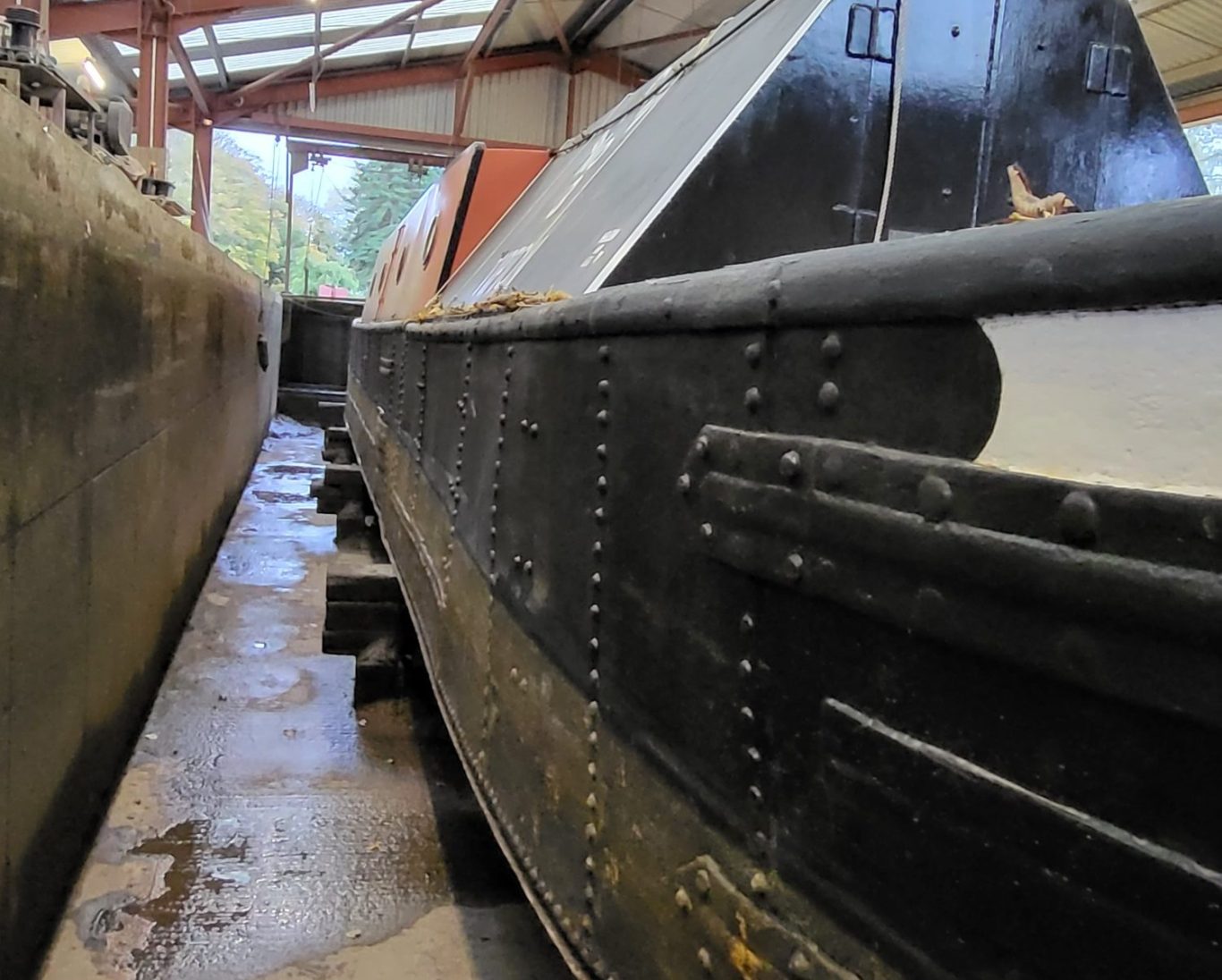
A few weeks ago, we surveyed a narrowboat that looked absolutely spot-on from the outside. Fresh blacking, tidy paintwork, no obvious red flags. The seller was confident, the buyer was keen, and everything seemed straightforward.
Then we switched on the torch.
What we found underneath that pristine bitumen coating was a different story entirely: deep pitting that had been quietly eating away at the hull steel for years. To the naked eye, everything looked fine. But as a qualified marine surveyor, we know that what you can't see is often more important than what you can.
This case is a perfect example of why a professional narrowboat survey isn't just a box-ticking exercise. It's the difference between buying a solid boat and buying someone else's expensive problem.
The Problem With Bitumen: It Hides More Than It Protects
Bitumen coating (often called "blacking") is the most common protective layer applied to narrowboat hulls. It's cheap, easy to apply, and does a decent job of keeping water away from the steel: when it's applied correctly and maintained regularly.
But here's the catch: bitumen is thick, black, and opaque. It's brilliant at masking what's happening underneath.
Over time, if the coating fails in even small areas: through minor impacts, poor application, or simple wear: moisture can seep through and start corroding the steel beneath. The bitumen then acts like a bandage over a festering wound. From the outside, it still looks perfectly intact. Underneath, the steel is thinning, pitting, and weakening.
We've seen boats with hull thickness readings of 2mm or less in localized areas, completely hidden under what appeared to be a fresh coat of blacking. In cases like that, the boat isn't just a bad buy: it's uninsurable and potentially unsafe.
How a Marine Surveyor Spots What Others Miss
So how do we find problems that are invisible to the untrained eye?
It starts with experience. A good marine surveyor has seen hundreds of hulls in every condition imaginable. We know where problems typically develop, what warning signs to look for, and how different coatings behave over time.
But experience alone isn't enough. We also use specialist tools and techniques that go far beyond a visual inspection.
The Torch Test
One of the simplest but most effective tricks in our toolkit is a high-powered LED torch. When you shine a bright light at a shallow angle across a bitumen-coated hull, you can often see subtle irregularities in the surface: tiny dips, ripples, or depressions that suggest something isn't right underneath.
In this particular case, that's exactly what happened. The bitumen looked smooth and uniform at first glance, but under the torch beam, we could see faint depressions in several areas along the waterline. These weren't impact dents or cosmetic blemishes: they were the telltale signs of underlying corrosion.
Ultrasonic Thickness Testing
Once we've identified suspicious areas, we move on to the real game-changer: ultrasonic hull thickness testing.
Using a specialized gauge (we use a Tritex 5750), we can measure the exact thickness of the steel hull through the coating, without needing to scrape it off or damage the blacking. The device sends ultrasonic waves through the steel and measures how long they take to bounce back, giving us an accurate reading in millimeters.
On a typical narrowboat built in the last 30–40 years, you'd expect base plate thickness of around 6mm when new, with 10mm on the swim (the curved section at the back). Safe operating thickness is generally considered to be 4mm minimum for base plates, though insurance companies and the BSS (Boat Safety Scheme) may have their own criteria.
In the areas where we'd spotted surface irregularities on this boat, our readings came back between 2.5mm and 3mm. That's borderline failure territory. Without ultrasonic testing, the buyer would never have known until the first leak appeared: or worse, until an insurer's surveyor rejected the boat outright.
The Real-World Consequences of Hidden Pitting
Let's be clear about what we're talking about here. This isn't just about aesthetics or resale value. Pitting corrosion is a structural issue that can have serious consequences:
1. Insurance Rejection
Most marine insurers require a recent survey before they'll cover a boat, especially for a new owner. If the survey reveals excessive pitting or hull thickness below safe limits, they'll either refuse cover entirely or impose expensive exclusions.
In this case, the buyer's intended insurer confirmed they wouldn't touch the boat without significant remedial work. That's an immediate deal-breaker for most people.
2. Safety Risks
Thin or pitted steel is weak steel. In extreme cases, it can lead to leaks, structural failure, or even catastrophic hull breaches. While narrowboats aren't ocean-going vessels, they still need to be watertight and structurally sound: especially if you're planning to live aboard or travel extensively.
3. Expensive Repairs
Fixing severe pitting isn't a quick job. Depending on the extent of the damage, you might be looking at shot-blasting, plate welding, or even overplating entire sections of the hull. That can easily run into thousands of pounds, plus the cost of dry-docking and re-blacking afterward.
The buyer in this case was able to walk away before signing anything, thanks to the survey. That saved them from inheriting a five-figure repair bill.
Why DIY Inspection Isn't Enough
We completely understand the temptation to save a few hundred quid by doing your own checks before buying a boat. A visual inspection, a magnet test, and a few questions to the seller can tell you something about a boat's condition.
But they can't tell you what's happening under the blacking. They can't measure hull thickness. And they can't give you the documented evidence that insurers and lenders require.
A professional hull survey gives you:
- Accurate ultrasonic thickness readings at multiple points across the hull
- A written report detailing any defects, risks, or areas of concern
- Photographic evidence of problem areas
- An expert opinion on whether repairs are needed and how urgent they are
- A document that satisfies insurance and finance requirements
It also gives you leverage. If a survey uncovers issues, you can renegotiate the price, ask the seller to carry out repairs, or walk away entirely. Without a survey, you're buying blind: and you'll have no recourse if problems emerge later.
What Happens During a Marine Survey?
If you've never commissioned a narrowboat survey before, here's what to expect.
We'll typically arrange to meet you (and the seller, if they're willing) at the boat's mooring. The survey itself usually takes 2–4 hours, depending on the size and complexity of the vessel.
During that time, we'll:
- Inspect the hull externally, ideally with the boat out of the water or on the slipway
- Carry out ultrasonic thickness testing on the base plate, chines, sides, and swim
- Check anodes for condition and placement (learn more about anode protection here)
- Assess the condition and type of blacking (bitumen vs. epoxy: here's our guide)
- Inspect internal steelwork, including floors, bulkheads, and the engine bay
- Test onboard systems (if it's a full condition survey rather than just a hull survey)
- Take photos and notes throughout
Within a few days, you'll receive a detailed written report covering everything we found, along with recommendations and an overall assessment of the boat's condition.
When to Book a Marine Surveyor
If you're thinking about buying a narrowboat, we'd recommend booking a marine surveyor at the earliest opportunity: ideally before you make a formal offer, or at the very least as a condition of sale.
Here are the key times when you absolutely need a professional survey:
- Before purchasing any used boat, especially if it's over 10 years old
- When your insurer requires a survey as a condition of cover
- If you're buying with a marine mortgage or loan (most lenders insist on a survey)
- When you're considering a boat that's been heavily refurbished or overplated
- If the boat hasn't been surveyed in the last 3–5 years
Don't be tempted to skip the survey just because a boat has recent blacking or looks well-maintained. As this case proves, appearances can be deeply misleading.
Protect Your Investment Before It's Too Late
The buyer in this story dodged a bullet. Without a professional hull survey, they would have bought a boat with hidden structural problems, faced insurance rejection, and been left with a repair bill that could easily have exceeded the boat's value.
That's exactly the kind of situation we help people avoid.
If you're looking at narrowboats and want peace of mind before you commit, get in touch with us to arrange a survey. We cover the Midlands and surrounding areas, and we're happy to travel for the right job.
You can also check out our pricing page for transparent, straightforward fees: or read some of our recent customer reviews to see what previous clients have said.
A survey isn't an expense: it's an investment in knowing exactly what you're buying. And when it comes to narrowboats, what you can't see is often the most important thing of all.
Want more narrowboat tips and behind-the-scenes looks at our latest surveys? Follow us on Facebook and Instagram!
Stop Worrying About Your Survey Results: What 'Thin Steel' Really Means for Your Narrowboat
We get it. You've just received your narrowboat survey results, and somewhere in that report are the words "thin steel" or "below 4mm." Your heart sinks. You're already imagining insurance companies rejecting you, expensive repairs, or, worst case, a boat that's structurally unsafe.
Take a breath. We're going to walk you through what "thin steel" actually means, why that 4mm number keeps popping up, and when you should genuinely be concerned versus when it's just industry convention talking.
The Panic That Comes With Survey Results
When you see measurements like 3.8mm or 3.5mm on your hull plates, it's natural to worry. We've seen countless boat owners lose sleep over these numbers, especially when they've already fallen in love with a boat or committed emotionally to a purchase.
The confusion often starts because there's a massive gap between what the industry says is acceptable and what engineering actually requires. And that gap? It's causing unnecessary stress for boat owners across the UK.
Understanding What "Thin Steel" Actually Means
First, let's clarify something important: thin steel doesn't automatically mean unsafe steel.
When we measure hull thickness during a survey, we're looking at how much metal remains after years of corrosion and wear. Modern narrowboats are typically built with a 10/6/4 specification, that's 10mm for the base plate, 6mm for the hull sides, and 4mm for the cabin sides.
But here's where it gets interesting: those numbers aren't about structural strength alone. They're largely about corrosion allowance.
Think of it like this, when a builder uses 10mm steel for the base plate, they're not saying you need 10mm for the boat to float safely. They're giving you a buffer so that even after 20, 30, or 40 years of corrosion, you'll still have adequate thickness remaining.
Localized Pitting vs. General Thinning: The Critical Difference
This is where many boat owners get confused, and honestly, some surveyors don't explain it clearly enough.
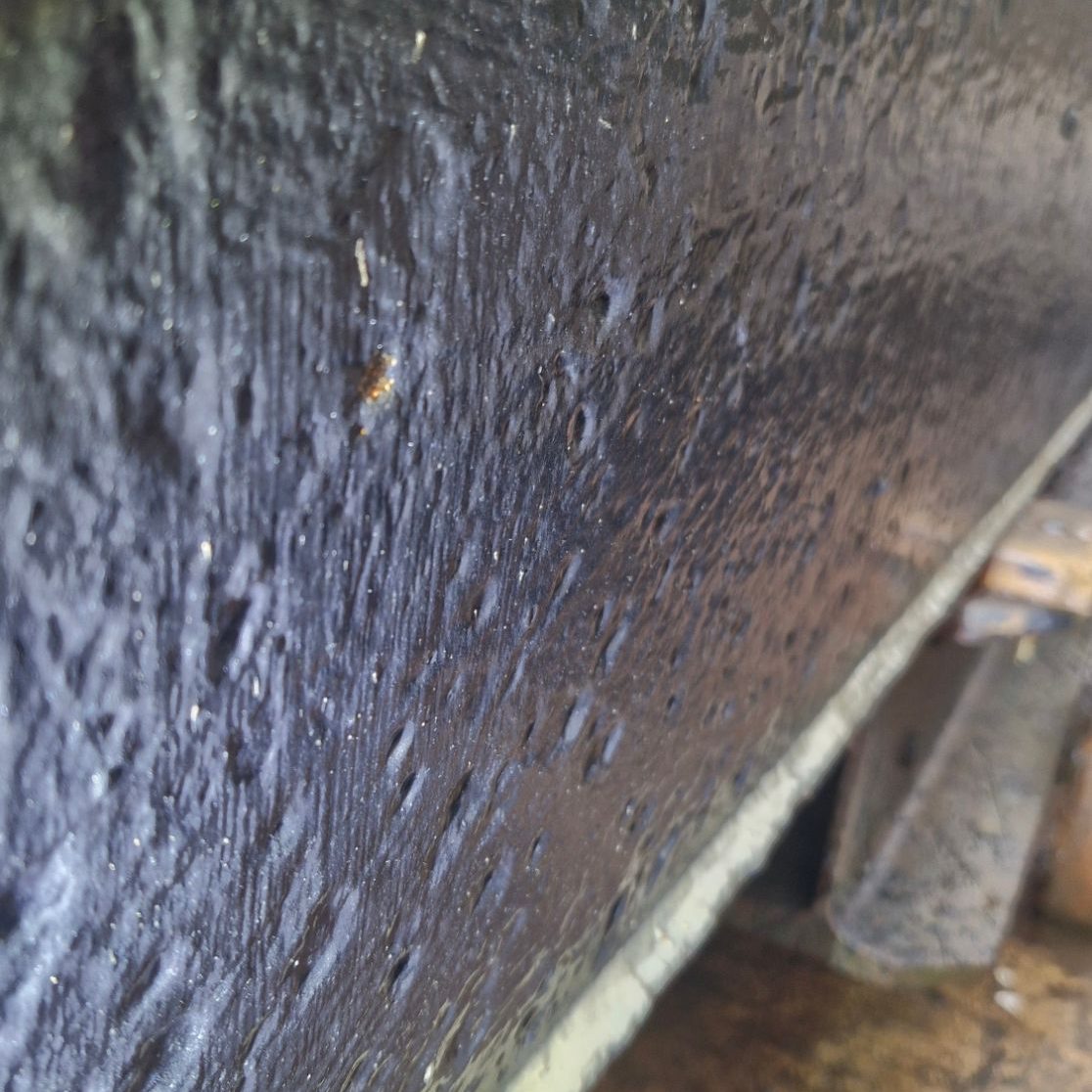
Localized pitting is when you have small areas of corrosion, think of them as little divots or craters in the steel. These might read as 3mm on an ultrasonic gauge, but they're surrounded by steel that's still 6mm or 8mm thick. Pitting is common, especially on older boats, and it's usually not a structural concern unless it's severe or widespread.
General thinning is a different beast entirely. This is when large sections of your hull have corroded uniformly down to thinner measurements. If your entire base plate has gone from 10mm to 3.5mm, that tells us something about the maintenance history and overall condition that's worth paying attention to.
When we conduct surveys, we're taking dozens, sometimes hundreds, of readings across the hull. A few low spots? Not unusual. Consistently low readings across large areas? That's when we start having deeper conversations about the boat's condition.
The 4mm "Rule" That Isn't Really a Rule
Right, let's tackle the elephant in the room: that infamous 4mm threshold.
You'll hear it from insurance companies, brokers, and even some surveyors. "Below 4mm and you're in trouble." But here's the truth: that 4mm figure is a convention, not an engineering fact.
The Canal Boatbuilders Association (CBA), the Maritime and Coastguard Agency (MCA), and respected naval architects like Dave Gerr all point to 3mm as the actual minimum design thickness for narrowboat hulls. Not 4mm. Not 5mm. Three millimetres.
Going back to the 1980s, Springer Engineering built perfectly sound narrowboats using 5mm steel throughout. These boats are still floating today with no structural failures. So why does everyone insist on 4mm?
Why Insurance Companies Use 4mm as a Threshold
Insurance companies aren't engineers: they're risk assessors. They've collectively decided that 4mm is a comfortable cutoff point that gives them confidence the boat will remain insurable for years to come.
It's not that a 3.7mm hull is unsafe. It's that insurance underwriters want a margin for error, especially since they're often dealing with boat owners who might not maintain their vessels perfectly.
Some insurers are more flexible than others. We've seen boats with readings of 3.5mm to 3.8mm get insured without issue, especially when the survey shows good overall condition, proper maintenance history, and sound plating where it matters most.
The key phrase here is "residual thickness after corrosion allowance." The MCA permits up to 25% wastage from design thickness. A well-maintained hull measuring 3mm can be both properly designed and perfectly insurable: if it's backed up by evidence of care and attention.
What You Should Actually Worry About
So when should you be concerned about thin steel? Here's what we look for:
Pooled water and internal corrosion: If there's standing water in the bilges or evidence of long-term moisture in rebates and joints, that's a red flag. Corrosion from the inside out is often more damaging than external corrosion.
Maintenance history: A boat that's been regularly blacked, properly anoded, and kept out of the water during winter months will age far better than one that's been neglected. Thickness readings need context.
Widespread thinning below 3mm: If we're consistently seeing readings under 3mm across large sections of the hull, especially the base plate, then we're moving into territory where structural integrity becomes questionable.
Failed hammer test results: Before we even break out the ultrasonic gauge, we're tapping the hull with a hammer. Sound, solid steel rings clearly. Thin or corroded steel sounds dull or dead. If the hammer test raises concerns, the thickness readings matter more.
When 3.5mm Is Fine and When It's Not
Context is everything. A 40-year-old boat that reads 3.5mm on the base plate but has been meticulously maintained, shows no internal corrosion, and passes hammer testing? We'd have no concerns recommending that boat.
A 15-year-old boat with 3.5mm readings, evidence of poor maintenance, pitting on the inside, and dull hammer test results? That's a different conversation entirely.
This is exactly why you need a thorough survey that goes beyond just taking readings. We're looking at the whole picture: the story the boat tells us about how it's been treated and what challenges it might face moving forward.
What To Do If Your Survey Shows Thin Steel
If your survey comes back with concerning thickness readings, don't panic. Here's what we typically recommend:
First, understand where the thin areas are. Localised spots can often be plated over. General thinning across the base might require more extensive work, but it's still repairable.
Second, talk to your insurance broker honestly. Some companies are more flexible than others, and having a detailed survey report that contextualises the readings can make all the difference.
Third, get quotes for remedial work if needed. Overplating can extend a boat's life significantly, and depending on the extent of work needed, it might be more affordable than you think.
Finally, don't let a single number derail a purchase you're excited about, but don't ignore genuine red flags either. This is where having an experienced surveyor who can interpret the results and give you honest advice becomes invaluable.
The Bottom Line on Thin Steel
"Thin steel" isn't the death sentence many boat owners fear it is. The 4mm threshold is an insurance convention, not engineering gospel. The real minimum for structural safety is 3mm, and even boats measuring below 4mm can be perfectly sound, insurable, and safe.
What matters more than any single thickness reading is the overall condition of the vessel, its maintenance history, and whether there's evidence of ongoing corrosion that needs addressing.
We understand how overwhelming survey results can feel, especially when you're already emotionally invested in a boat. Our job isn't to scare you with numbers: it's to give you the full picture so you can make an informed decision about your purchase.
If you're concerned about thickness readings in a survey you've received, or you want a thorough pre-purchase inspection that puts those numbers in proper context, we're here to help. We'll give you honest, straightforward advice about what you're looking at and what it means for your boat's future.
Want more narrowboat tips and behind-the-scenes looks at our latest surveys? Follow us on Facebook and Instagram!